FATF Recommendation 16 and the Travel Rule: A Technical Guide
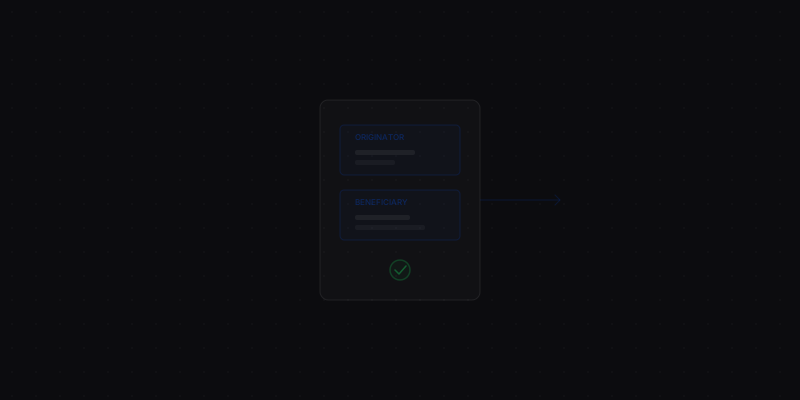
The Financial Action Task Force Recommendation 16, commonly known as the Travel Rule, is one of the most important and most poorly implemented regulations in international payments. It requires that specific information about the originator and beneficiary of a wire transfer "travel" with the payment throughout the entire correspondent chain. The concept is simple. The implementation is anything but.
What the Travel Rule Requires
Recommendation 16 specifies that for cross-border wire transfers, the originating institution must include the following information with the payment message: the originator's name, account number, address (or national identity number, or date and place of birth), and the beneficiary's name and account number. For transfers above applicable thresholds, all fields are mandatory. For transfers below the threshold, a subset is required but must be available upon request.
The rule applies to every institution in the payment chain. Intermediary banks must retain and pass along the originator and beneficiary information. If the information is missing, the intermediary must take reasonable measures to obtain it -- and if it cannot, it must consider whether to proceed with the transaction, restrict the business relationship, or file a suspicious activity report.
The Current State of Compliance
Despite being in effect for over two decades, Travel Rule compliance remains inconsistent across the global banking network. A 2024 FATF mutual evaluation found that only 58 percent of jurisdictions were substantially compliant with Recommendation 16. The reasons are primarily operational, not intentional.
Legacy SWIFT MT messages have limited field space for originator and beneficiary information. Banks in some jurisdictions have systems that cannot capture all required fields. Manual data entry introduces errors and inconsistencies. And there is no standardized format for the information -- a name might appear as "John Smith," "SMITH, JOHN," or "J. Smith" depending on the originating system.
How AICIL Automates Travel Rule Compliance
AICIL addresses Travel Rule compliance by creating structured data objects that contain all required originator and beneficiary information in a standardized, machine-readable format. When a transaction is submitted through AICIL, the system validates that all Recommendation 16 fields are present and correctly formatted before the payment enters the SWIFT network.
The structured data object uses ISO 20022 field definitions, ensuring compatibility with the evolving global payment messaging standard. Entity names are normalized to a canonical format. Addresses are validated against postal databases. Account numbers are verified using IBAN check digits where applicable. The result is a Travel Rule compliance object that can be validated programmatically by any downstream institution.
Cross-Jurisdictional Threshold Mapping
One of the technical challenges of Travel Rule compliance is that different jurisdictions implement different thresholds. The United States requires full originator information for transfers of $3,000 or more. The European Union sets the threshold at EUR 1,000. Some jurisdictions apply Recommendation 16 to all transfers regardless of amount.
AICIL maintains a jurisdiction-threshold map that is updated as regulations change. When generating a compliance package, the system identifies every jurisdiction the payment will transit (using the correspondent chain prediction model) and applies the strictest applicable threshold. This ensures that the package satisfies requirements across all jurisdictions in the chain, not just the originating jurisdiction.
The Path to Full Compliance
The Travel Rule is not a new regulation, but full compliance has eluded the industry for decades. The core problem is not that banks do not want to comply -- it is that the infrastructure for passing structured originator and beneficiary information through a multi-hop correspondent chain did not exist. ISO 20022 provides the message format. AICIL provides the automation layer. Together, they make full Travel Rule compliance achievable at scale for the first time.