Graph-Based Correspondent Chain Prediction
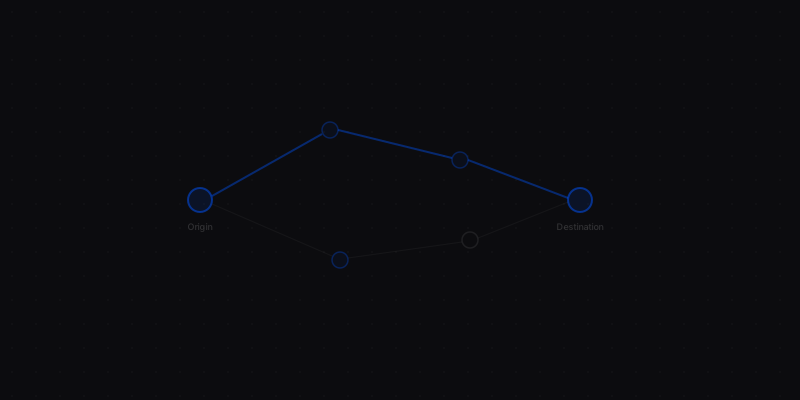
When a bank initiates a cross-border wire transfer, the payment does not teleport from originator to beneficiary. It traverses a chain of correspondent banks -- intermediaries that maintain accounts with each other and pass the payment along until it reaches its destination. Predicting the exact chain a payment will follow is one of the most valuable and least-explored problems in cross-border payments.
The Correspondent Banking Graph
AICIL models the global correspondent banking network as a directed graph in Neo4j. Each node represents a financial institution, annotated with attributes: jurisdiction, SWIFT BIC, regulatory status, sanctions exposure, and historical transaction volume. Each edge represents a correspondent relationship, annotated with the currencies supported, the average processing time, the acceptance rate for incoming payments, and the documentation requirements.
The current graph contains over 50,000 bank nodes and 200,000 correspondent relationships, built from publicly available SWIFT directory data, regulatory filings, and transaction-outcome observations. The graph is not static -- relationships are added, modified, and removed as the correspondent banking network evolves.
Chain Prediction as Path Ranking
Given an originator bank and a beneficiary bank, the chain-prediction problem reduces to ranking possible paths through the graph. For a USD payment from a bank in Vietnam to a bank in Brazil, there might be dozens of possible 2-hop, 3-hop, or 4-hop paths through intermediary correspondent banks.
AICIL uses a graph neural network (GNN) trained on historical transaction data to rank these paths by predicted success probability. The model considers edge-level features (acceptance rates, processing times, documentation requirements) and node-level features (jurisdiction risk, regulatory status, historical flag rates) to produce a confidence score for each candidate chain.
Per-Bank Reward Profiles
One of the most powerful features of the graph model is per-bank reward profiles. Each correspondent bank has implicit preferences that affect whether it will process a given payment smoothly. Some banks prefer structured PDF compliance documents; others require specific XML schemas. Some flag payments above certain thresholds for manual review; others have automated pass-through for pre-verified packages below a risk score.
AICIL learns these preferences from outcome data. When a compliance package is accepted by Bank A but delayed by Bank B for the same transaction type, the model updates its understanding of each bank's reward profile. Over time, this creates a detailed map of what each correspondent bank expects -- enabling AICIL to tailor the compliance package to the predicted chain.
Confidence Scoring and Fallback Chains
Chain prediction is inherently uncertain. Correspondent relationships can be suspended without notice, processing times vary, and bank policies change. AICIL addresses this by producing a ranked list of candidate chains with confidence scores, rather than a single prediction.
If the primary predicted chain has a confidence score of 0.92 and the secondary chain scores 0.87, AICIL generates compliance packages optimized for both chains. If the payment is rerouted mid-transit, the pre-generated package for the fallback chain is already available. This redundancy eliminates the delays that occur when a payment arrives at an unexpected correspondent bank without the right documentation.
Why Graphs, Not Tables
Relational databases can store correspondent banking data, but they cannot efficiently answer the questions that matter for chain prediction. Queries like "find all 3-hop paths from Bank A to Bank B where every intermediary has an acceptance rate above 95 percent and supports EUR clearing" require recursive joins that are computationally expensive in SQL but native to graph traversal. Neo4j processes these queries in milliseconds, making real-time chain prediction feasible at transaction time.