The Shift from Reactive to Pre-Emptive Compliance
For decades, anti-money-laundering (AML) compliance has operated on a single principle: flag first, investigate later. A cross-border wire transfer enters the SWIFT network, lands at the beneficiary bank, and only then does the compliance machinery kick in. Analysts pull records, check sanctions lists, request supporting documents, and make a judgement. If the package is incomplete, the payment stalls. If the flag is a false positive -- and roughly 80 to 95 percent of them are -- the bank has wasted hours of analyst time on a transaction that was legitimate from the start.
The Cost of Reactive Workflows
The numbers are staggering. Industry estimates peg the global cost of financial-crime compliance at over $40 billion annually, and that figure does not include the opportunity cost of delayed settlements. A typical cross-border wire that triggers a compliance hold faces a 3 to 5 business-day delay while analysts manually assemble the required documentation. For corporate treasury teams managing hundreds of international payments per month, those delays cascade into missed FX windows, strained supplier relationships, and working-capital inefficiency.
The root cause is structural. Legacy compliance workflows assume that documentation should be assembled after the transaction is initiated. The originating bank sends the payment instruction, and every downstream correspondent bank independently verifies the same information -- often requesting the same documents multiple times across the chain.
The Pre-Emptive Paradigm
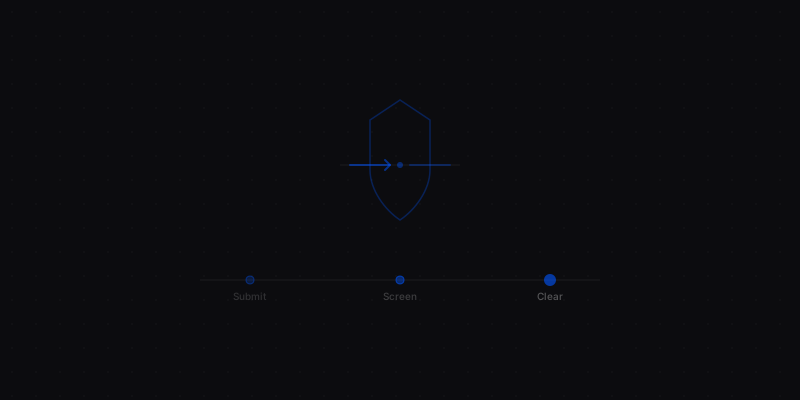
Pre-emptive compliance inverts this model. Instead of assembling documentation after a flag, the compliance package is generated before the wire is sent. The package includes sanctions screening results, beneficial ownership verification, source-of-funds documentation, and risk scoring -- all structured, machine-readable, and cryptographically signed.
The package travels alongside the SWIFT message as a companion data object. When the payment arrives at a correspondent bank, the compliance team does not start from scratch. They validate the pre-assembled package against their own policies, which takes minutes instead of days.
Why Now
Three converging forces make pre-emptive compliance viable today. First, ISO 20022 adoption gives SWIFT messages rich, structured data fields that legacy MT formats lacked. Second, sanctions list APIs from OFAC, EU, UN, and HMT now support real-time programmatic access. Third, advances in natural language processing allow automated extraction of entity information from unstructured corporate documents.
The result is a system that can assemble a complete, regulator-ready compliance package in under two minutes -- before the wire is even submitted to the network. False positives are resolved at origination, not downstream. Settlement times compress from days to hours. And the 80 to 95 percent of alerts that were always legitimate never generate a hold in the first place.
What Changes for Banks
For originating banks, pre-emptive compliance reduces the probability that their wires will be held or returned. For correspondent banks, it dramatically lowers the cost of processing incoming payments from verified originators. For regulators, it creates a more transparent, auditable system where compliance decisions are documented before value moves.
This is not an incremental improvement to existing workflows. It is a structural change in how compliance information flows through the correspondent banking network. The shift from reactive to pre-emptive is the single largest efficiency gain available in cross-border payments today.